Physical Address
304 North Cardinal St.
Dorchester Center, MA 02124
Physical Address
304 North Cardinal St.
Dorchester Center, MA 02124


History tends to sanitize the geniuses it adopts. We usually remember Nikola Tesla as the refined, white-gloved inventor of the AC motor. However, the Nikola Tesla origins are far darker and more complex than a standard biography suggests. To truly understand the “Master of Lightning,” we must look at a childhood defined by neurological anomalies, family tragedy, and a literal negotiation with death. At zomby.org, we believe his power didn’t come from his books, but from his blood.
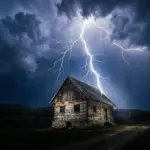
The mid-19th century was a world lit by whale oil and governed by the slow pace of steam. Consequently, into this world, the Nikola Tesla origins began with a massive meteorological anomaly. At exactly midnight, July 10, 1856, in the village of Smiljan, a lightning storm of “unprecedented violence” broke over the Balkan mountains. This wasn’t just a dramatic backdrop; rather, it served as a foundational myth for his entire career.
“The lightning was so frequent that the room was never dark. The midwife called it a curse. My mother called it a baptism.” — *Tesla family oral history, archived at the Tesla Museum.*

Furthermore, his mother, Djuka Mandic, was the daughter of a priest and the wife of another. Yet, amidst the religious dogma of the era, she possessed a preternatural understanding of mechanics. While his father, Milutin, spent his days buried in liturgy, Djuka spent hers “inventing” solutions for survival. For instance, she created the tools that ran their farm. These included complex mechanical looms and specific kitchen implements that utilized gears and levers—technologies she had never seen, but simply “knew” how to build.

A major, often ignored element of the Nikola Tesla origins is the death of his older brother, Dane. By all accounts, Dane was the “true” genius of the family. At age 12, Nikola watched as Dane was killed in a riding accident. Following this event, the loss shattered the family’s dynamic forever.

For the rest of his life, Nikola lived in the shadow of a ghost. Because his parents’ grief was so profound, Nikola felt he could never measure up to his brother’s lost potential. This trauma fueled an obsessive, almost neurotic drive to achieve the impossible. In addition to being about science, this was about proving he deserved to be the son who lived. This “survivor’s guilt” is the hidden engine behind his work ethic, which often saw him sleeping only two hours a night for decades.
What sets the Nikola Tesla origins apart from contemporary inventors like Edison or Westinghouse is his brain chemistry. Specifically, Tesla benefited from a condition today’s neurologists might call Hyperphantasia combined with Synesthesia. Starting in early childhood, certain words would trigger blinding flashes of light. Subsequently, these flashes were followed by vivid, 3D hallucinations of objects.

| Condition | Manifestation |
|---|---|
| Object Projection | He could see a machine “floating” in front of him with 100% clarity. |
| Internal Testing | He would “run” motors in his mind for weeks to check for wear. |
| Light Sensitivity | Sudden insights were always preceded by a blinding flash of white light. |
He famously claimed he never needed to draw a blueprint. He once stated: *”I do not rush into actual work. When I get an idea, I start at once building it up in my imagination.”* As a result of this biological anomaly, he could bypass the “trial and error” phase that slowed down every other engineer in history.
By age 17, the Nikola Tesla origins hit a dead end. His father, a man of God, demanded that Nikola enter the priesthood. Nikola, obsessed with the physical laws of the universe, refused. This stalemate ended when Nikola contracted cholera. For nine months, he lay paralyzed by the disease. Eventually, his doctors gave up hope, and his family began preparing for a second funeral.

In a moment that feels like a scene from a gothic novel, Nikola looked at his father and made a deal with death. “Perhaps,” he whispered, “I may get well if you will let me study engineering.” Terrified of losing another son, Milutin relented. He promised Nikola he would go to the best technical institution in Europe. Within days, the fever broke. Tesla’s recovery was so rapid it was whispered to be miraculous, but Nikola knew the truth: he had finally won his freedom.
Most biographies skip his years at the Polytechnic Institute in Graz, Austria. However, this is where the Nikola Tesla origins took a dark turn. Tesla was a star student, working from 3 AM to 11 PM. Unfortunately, his obsessive nature had a flip side: a crippling gambling addiction. He lost his tuition money, his living expenses, and his pride at the card tables.

He dropped out of school, cut off his family, and disappeared into a world of manual labor. During this period of depression, he suffered a nervous breakdown. Simultaneously, his sensory perceptions became hypersensitive. He claimed he could hear a watch ticking three rooms away. This wasn’t a breakdown—it was a recalibration of his nervous system for the work ahead.
In 1882, a recovered but fragile Tesla moved to Budapest. While walking through the City Park with a friend at sunset, the Nikola Tesla origins reached their “Eureka” moment. He was reciting lines from Goethe’s *Faust*—a poem about a man who sells his soul for knowledge. As he spoke the words about the sun’s energy, a flash of light blinded him.
Suddenly, he saw the Rotating Magnetic Field. He saw the AC motor not as a machine of copper and iron, but as a dance of invisible forces. Without a pen or paper, he used a stick to draw the schematic in the park’s soil. That dirt drawing solved the problem that Thomas Edison, the most famous man in the world, had deemed “impossible.”