Physical Address
304 North Cardinal St.
Dorchester Center, MA 02124
Physical Address
304 North Cardinal St.
Dorchester Center, MA 02124


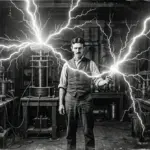
In 1899, Tesla moved his research to the high altitudes of Colorado Springs. He specifically needed an environment to test the limits of ground waves. This research created the foundation of Nikola Tesla and the Wireless Dream. During this time, he built a laboratory that looked like a simple barn. In fact, it contained a “Magnifying Transmitter” capable of generating millions of volts. This device wasn’t just a powerful transformer; it was a complex engineering tool designed to manipulate the very potential of the planet.
Tesla discovered that the Earth was a highly conductive sphere. By shaking the Earth’s electrical charge at the correct frequency, he created a standing wave. Furthermore, this discovery allowed him to retrieve energy at any location. For example, he proved this by lighting 200 light bulbs stuck into the ground over 25 miles away. Publicly archived documents at Google Patents show his specific method for this wireless transmission. In these high-voltage color noir photographs from that era, we see blinding electric blue and purple discharges, confirming the incredible voltage he was manipulating.

Consequently, the local utility company grew angry. When Tesla’s massive draw of current destroyed their primary generator, the entire city fell into darkness. Therefore, the company asked him to leave. However, Tesla did not care about the eviction. He possessed the data and knew the Wireless Dream was physically possible. He had observed terrestrial stationary waves, a discovery that effectively proved the Earth could act as a giant conductor.
Tesla returned to New York and began construction on his masterpiece, the Wardenclyffe Tower. Although textbooks describe it as a radio tower, Tesla’s private notes reveal a much more aggressive goal. The Library of Congress preserves these records today. Specifically, he wanted to inject power directly into the planet.
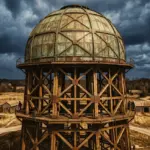
The tower featured a 187-foot wooden lattice and a 55-ton copper dome. In addition, workers drove iron pipes 120 feet into the ground. Tesla called this his “Terrestrial Syringe.” By grounding the tower deep into the water table, he used the Earth as a literal battery. He believed that gripping the Earth would allow him to make the entire planet vibrate with energy. Engineering this scale required incredible innovation; the 16:9 full-color noir images of the construction phase, featuring warm sepia wood patina and amber rust, visually confirm the intricate complexity of the massive skeletal wooden octagonal frame.

Engineering such a structure required unprecedented precision. Tesla insisted on using non-magnetic materials for the tower’s frame to avoid interference. Furthermore, the subterranean shaft contained complex machinery designed to ‘pulse’ the Earth’s crust. If completed, the tower would have functioned as a planetary heartbeat.
Thomas Edison, meanwhile, began his transition into a corporate charlatan. He realized that Tesla’s success posed a death blow to his business model. Historically, Edison built a career by taking credit for the work of his hired employees. Therefore, he refused to let an immigrant genius outshine him.
The execution of Topsy the elephant at Coney Island in 1903 became the dark heart of Edison’s smear campaign. Although the War of Currents had ended, Edison used the event to film and distribute propaganda. Specifically, he wanted to show the danger of high-voltage electricity. By making the public associate electricity with death, Edison hoped to destroy Nikola Tesla and the Wireless Dream. He painted wireless ambitions as a public safety nightmare. The full-color noir night images of Luna Park, Cone Island, cast in warm sepia lighting against a deep dark blue sky, communicate the heavy, ominous atmosphere Edison intentionally cultivated.

The financial establishment found a safer alternative in Guglielmo Marconi. Although Marconi’s technology was primitive, it had one major advantage. Specifically, it only allowed for communication. Companies could easily charge for communication. Power, however, presented a problem for bankers.
If Tesla’s system succeeded, people could simply stick an antenna in the ground for free electricity. Therefore, the financiers chose the metered solution. When Marconi sent his first signal in 1901 using 17 of Tesla’s patents, the financial world crowned him the winner. Consequently, Tesla’s funding began to dry up. The full-color noir images of Marconi’s primitive gear—rough copper coils and sepia-toned glass resting on a worn dark mahogany table—visually confirm the crude complexity the market preferred over Tesla’s elegant resonance.

J.P. Morgan initially invested $150,000 into Wardenclyffe. However, Morgan valued control over science. He held massive monopolies in copper mining and rubber insulation. Consequently, Nikola Tesla and the Wireless Dream would have destroyed Morgan’s empires in a single afternoon. If power traveled through the air, nobody would buy Morgan’s copper wire.
When Tesla finally admitted the tower’s true purpose, Morgan asked a famous question. Specifically, he asked where the company would put the meter. Immediately after this meeting, Morgan cut all funding. Furthermore, he used his influence to prevent other banks from backing the project. Therefore, he effectively put a financial kill switch on the future of free energy. The full-color noir images of this specific high-stakes meeting, featuring Morgan shrouded in rich mahogany sepia leather and Tesla pointing intensely at blueprints lit by a single warm desk lamp, visually capture the tension of this historical convergence.

By 1917, the dream had become a skeletal ruin. Tesla lived in hotel rooms while creditors hounded him. In a final act of destruction, the U.S. government ordered the demolition of the Wardenclyffe Tower. Although they claimed it was a security risk during the war, the true motive aimed for permanent erasure.
Workers used dynamite to destroy the tower on July 4th, 1917. The dream of free global energy became scrap metal to pay off Tesla’s hotel debts. Consequently, the man who saw the 21st century in 1900 was left to feed pigeons. Meanwhile, the world moved forward with a fossil-fuel economy that still struggles for efficiency today. The full-color noir images of this final act—depicting skeletal wooden octagonal frame collapsing amidst massive sepia dust clouds and explosive charcoal-grey smoke—visually capture the tragic nature of this historical intervention.